How Long Does a Septic System Actually Last? Signs It’s Time to Replace, Not Repair
If your system’s getting up there in age, or you’re trying to figure out whether a repair is a real fix or just delaying the inevitable, here’s what actually determines a septic system’s lifespan in the Midlands — and how to tell which side of that line you’re on.
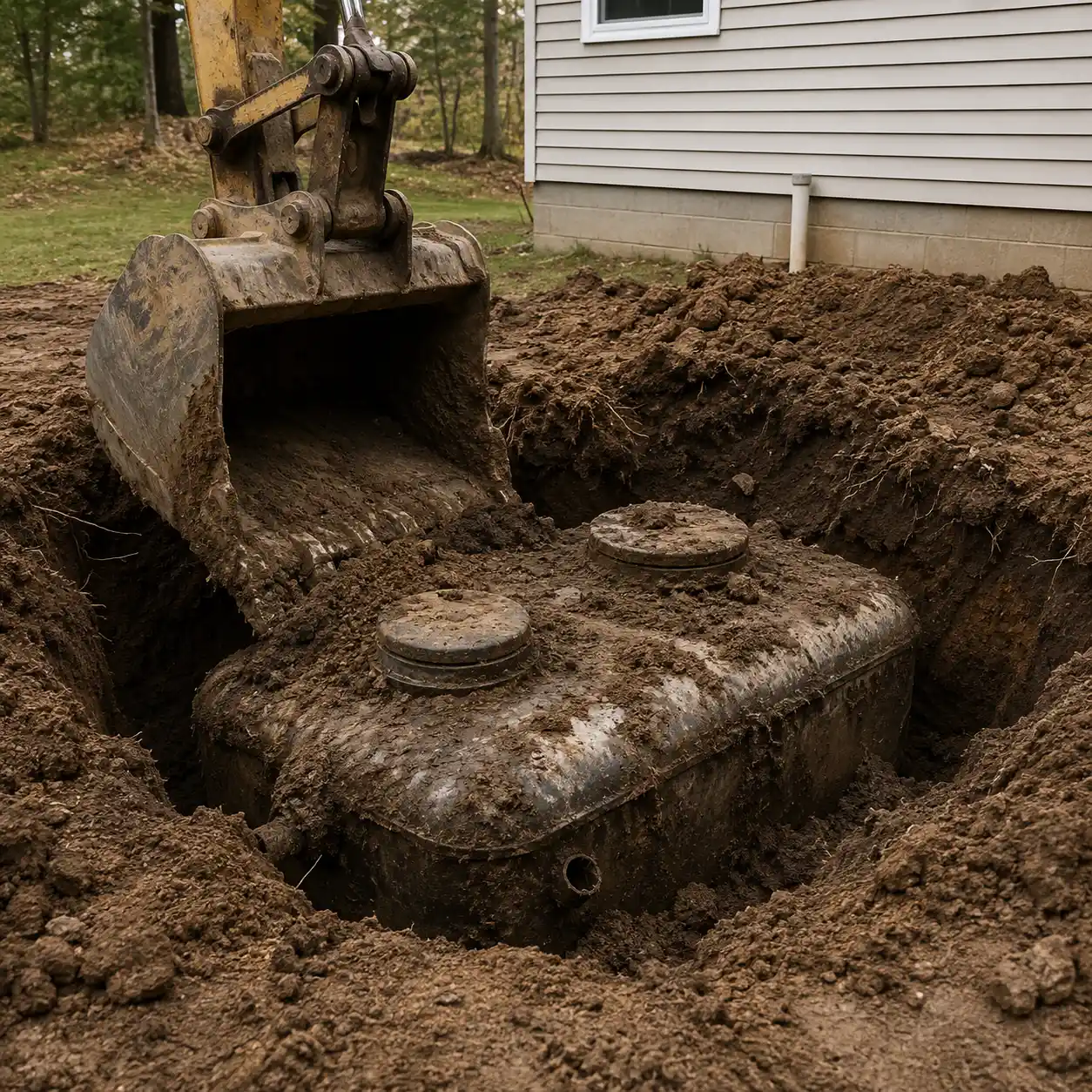
The “Answer” Everyone Gives — And What It Misses
Search this question and you’ll get some version of “20 to 30 years” as the answer, and as a rough average, that’s not wrong. What it misses is that a septic system isn’t one single component with one lifespan — it’s a tank, a distribution box, and a drain field, and each of those ages at a different rate depending on what it’s made of and what soil it’s sitting in.
In the Midlands specifically, the drain field almost always wears out well before the tank does, and where your property sits relative to the Fall Line has a real, measurable effect on how long that field holds up. A property on sandy Sandhills soil east of Columbia and one on denser clay near western Lexington County can see meaningfully different drain field lifespans even with identical maintenance habits.
This matters most in two situations: when you’re evaluating whether to keep repairing an aging system or start planning for its replacement, and when you’re buying a home and trying to gauge how many good years are realistically left in the system you’re inheriting. In both cases, a single average number across the whole country doesn’t tell you much. What tells you something useful is understanding which component you’re actually asking about, and what soil and maintenance history that specific system has behind it.
Expected Lifespan by Component and System Type
General ranges based on what we typically see in the field — your specific system’s history and maintenance record matter more than any table can capture.
These are general patterns based on common conditions across our service area — a system’s actual history, installation quality, and maintenance record can shift these numbers meaningfully in either direction.
A Case That Illustrates the Point
We regularly see two systems of nearly identical age end up in completely different situations. A 22-year-old system on sandy soil that’s been pumped consistently every four years can still be functioning well within normal parameters, with a field that shows no signs of stress. Meanwhile, an 18-year-old system on clay-heavy soil that went a decade without a single pump-out, on a property that’s added a bathroom since the original installation, can already be showing the kind of widespread saturation that points toward replacement.
Neither of those outcomes is unusual, and neither would have been obvious just from knowing the system’s age on paper. That’s really the core point of this whole guide: age is a starting reference, not a verdict, and the only way to get a reliable answer for your specific system is to have someone actually look at it.
This is also why we’re cautious about giving a firm number over the phone before ever seeing a property. We can offer a reasonable range based on soil type and rough age, but pinning down where a specific system actually stands takes an on-site look at tank condition, field saturation, and whatever service history is available. If you’re weighing a repair decision or trying to plan a budget for the next several years, that on-site look is worth the time it takes — a wrong guess in either direction, spending on a repair that won’t hold or replacing a system with real years left, costs more than the evaluation itself.
Why the Range Is So Wide
Maintenance history is the single biggest variable within any of these categories. A tank pumped on a consistent three-to-five-year schedule protects the drain field from the solids that cause premature failure, while a tank that’s gone a decade or more without service has likely already sent some solid material downstream — meaning the field’s real remaining lifespan could be shorter than its age alone would suggest.
Usage patterns matter too. A household that’s grown from two people to five without ever reevaluating whether the original system was sized for that load puts more strain on the field year over year than the system’s design accounted for. And installation quality, which is largely invisible once the ground is backfilled, plays a bigger role than most homeowners realize — a field installed to the letter of code on marginal soil tends to underperform one installed generously on excellent soil, even if both technically “passed” at the time.
What “Maintenance History” Really Means
When we talk about maintenance history extending a system’s lifespan, we don’t just mean pumping on schedule, though that’s the biggest single factor. It also includes things like never having planted a tree near the field, not routing a sump pump or gutter downspout into the septic system (a surprisingly common mistake that overloads a field with rainwater it was never meant to handle), and catching small problems — a slightly loose lid, an early warning sign — before they become bigger ones.
None of this requires expert-level attention. It mostly requires not ignoring the system for years at a stretch and treating a septic inspection as a genuine checkup rather than something to skip until a home sale forces the issue.
Not Sure Where Your System Stands?
A full inspection tells you what shape it’s actually in.
Schedule an Inspection
Serving Columbia and all of the Midlands.
Signs It’s Repair, Not Replace
A localized problem — one damaged section of field line, root intrusion in a specific spot, a cracked baffle in an otherwise sound tank — is usually repairable, especially in a system that’s still within its expected lifespan window. If the rest of the field is functioning fine and the issue traces back to a single identifiable cause, repair is almost always the more sensible starting point.
Age alone isn’t automatically disqualifying, either. A well-maintained 20-year-old system on good soil can have plenty of useful life left, while a poorly maintained 10-year-old one on marginal soil might not. This is exactly why a diagnosis matters more than a birthday.
It’s also worth asking whether a repair is a genuine fix or a temporary patch on a system that’s fundamentally reaching the end of what its soil and design can support. A repair that addresses a clearly isolated cause tends to hold for years. A repair that’s essentially treating a symptom of a field that’s simply run out of capacity tends to need a follow-up repair sooner than anyone would like — which is worth factoring into the decision even when a repair is technically possible.
Signs It’s Replace, Not Repair
Widespread saturation across the entire field, rather than one section, is the clearest signal that repair options are running out — you can’t spot-fix your way out of a field that’s failing broadly. Repeated failures in different areas of the same field over a short span is another red flag, since it suggests the underlying system was undersized or the soil conditions were never quite right for what was installed.
If your system is well past the upper end of its expected range for its soil type and showing multiple symptoms at once — odor, slow drains, and visible surface wetness together, rather than just one — that combination usually means the underlying capacity is gone, not just one component. At that point, a proper site evaluation for a new system is the more honest path forward than sinking money into repairs that won’t hold.
There’s also a cost-comparison angle worth being clear-eyed about. A single field repair might run a fraction of a full replacement, which makes it tempting to keep patching an aging system indefinitely. But if you’re facing a second or third repair within a few years on the same aging field, the math often favors replacement — you’re not just paying for the repair itself, you’re paying for the diagnostic visits, the disruption, and the fact that the underlying capacity problem never actually goes away between fixes.
Find Out What Shape Your System Is Really In
A full evaluation gives you an honest repair-versus-replace answer, not a guess based on age alone.
- Tank & baffle condition check
- Drain field saturation assessment
- Repair-vs-replace recommendation
- Written findings with photos
- Soil-specific lifespan guidance
- Serving all of the Midlands
Tell Us About Your Needs
We’ll reach out to confirm your appointment details.