How Often Should You Pump Your Septic Tank?
The “every three to five years” rule gets repeated so often that most homeowners never hear the rest of the story. Here’s what actually drives that number for a specific household, and where the real range tends to land for properties across the Columbia area.
The Short Answer, and Why It’s Only a Starting Point
Every three to five years is the guidance you’ll find on nearly every septic resource out there, and it’s not wrong. For an average household with a properly sized tank and normal water use, that interval holds up reasonably well as a baseline. It’s the number we’d give someone who called and asked for a quick answer with no other details.
What that rule leaves out is almost everything that actually determines your specific interval. Household size, tank size, how much water your home uses on a given day, whether a garbage disposal runs daily, and even the soil your drain field sits in all push that number up or down. Two houses of the same size on the same street can end up on genuinely different pumping schedules once you account for how each one is actually used. The rest of this guide walks through the variables that matter and gives you a more useful starting point than a single blanket number.
Pumping Frequency by Household Size and Tank Size
This table gives a reasonable starting range for a typical household with average water use and no unusual factors at play. Treat it as a planning tool, not a guarantee — the sections below explain what can shift your household toward the shorter or longer end of each range.
These ranges assume average daily water use and a tank in generally good condition. Garbage disposals, older tanks, and heavier-than-average laundry or dishwasher use all push toward the shorter end of each range.
Why Household Size Isn’t the Only Variable
A garbage disposal is probably the single biggest factor that gets left out of the simple version of this guidance. Every scrap of food it grinds up still ends up in the tank as solid waste, and that waste doesn’t break down as quickly or completely as most people assume. A household that runs a disposal daily can generate noticeably more solid buildup than one that scrapes plates into the trash, even with the same number of people living there.
Laundry habits matter too, especially in larger households doing several loads a week. Water use spread evenly across a week gives a tank time to properly settle solids between fill-ups. Water use concentrated into a couple of heavy days — everyone showering back to back, several loads of laundry run in a row — pushes more volume through the system at once and gives solids less time to separate out before liquid moves on to the drain field.
Tank age and condition are the other piece that a table can’t capture. An older tank with some settling or a baffle that’s degraded doesn’t hold solids as effectively as it did when it was new, which means a system that used to comfortably go five years between pump-outs might genuinely need attention closer to every three.
How Soil Type Changes the Math
Pumping frequency is mostly about the tank, but the drain field’s condition affects how much margin for error you actually have. In the sandier ground common around Gaston, Pelion, and parts of southern Lexington County, a field generally drains fast, which means a tank that’s slightly overdue for pumping is less likely to cause an immediate backup — the field has more capacity to absorb the extra load in the short term.
On the heavier clay-loam soil closer to Lake Murray and the Piedmont edge around Lexington and Chapin, a field has less margin. Water moves through that soil more slowly, so a tank running past its interval is more likely to send solids downstream into a field that’s already working harder to keep up. If your property sits on that heavier soil, we’d generally suggest sticking closer to the shorter end of the ranges above rather than stretching toward the longer end.
Not Sure Where Your Tank Stands?
We can check your tank’s condition and tell you honestly whether it’s due.
Schedule Septic Pumping
Serving Columbia and all of the Midlands.
What Actually Happens During a Pumping Visit
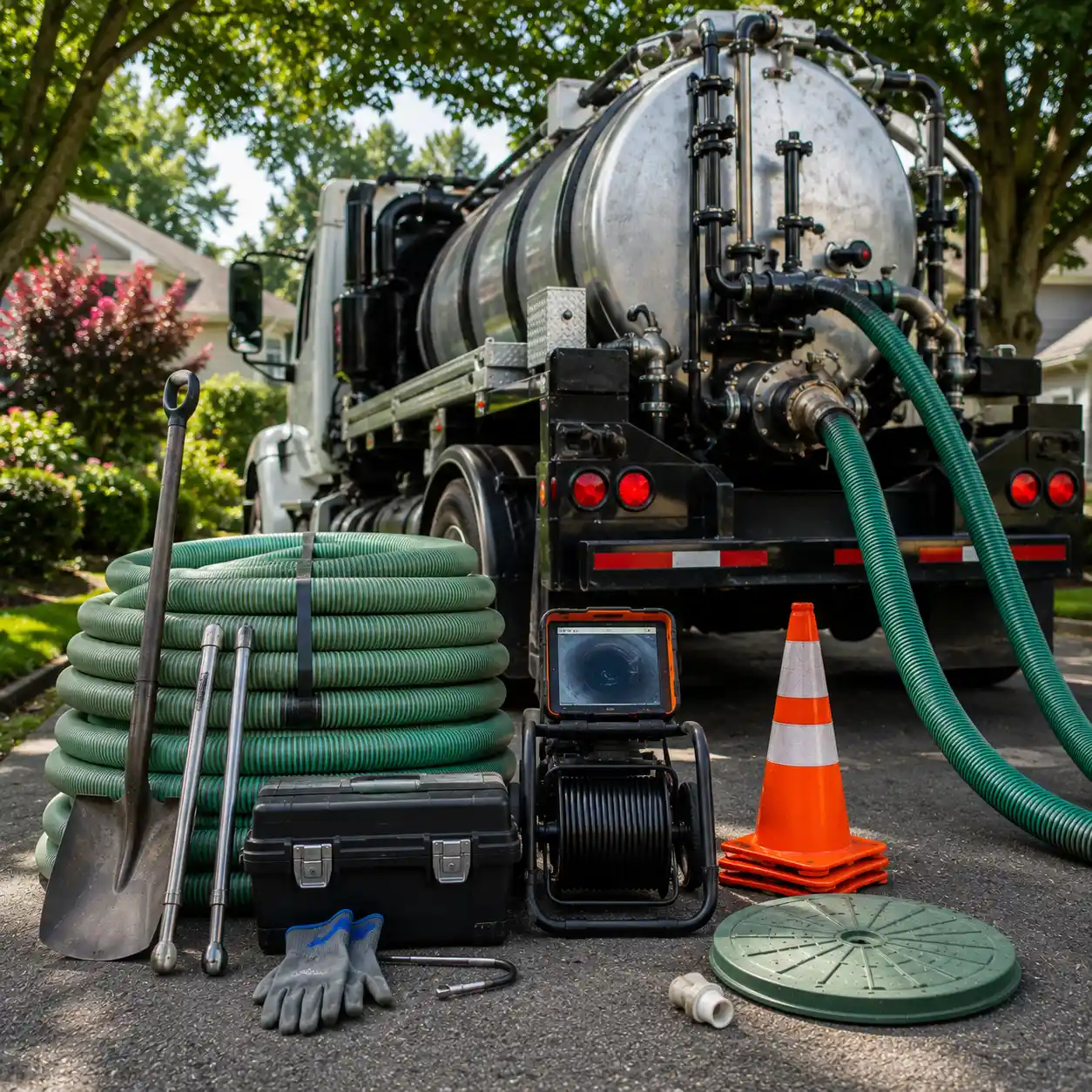
A pumping visit is more diagnostic than people expect. We locate and uncover the tank lid, then use a vacuum truck to remove the liquid layer along with the sludge that’s settled on the bottom and the scum layer floating on top. Removing all three matters — a visit that only takes the liquid off the top and leaves solids behind doesn’t actually reset the clock on your system, even though it might look like the tank emptied out fine.
While the tank is open, we also get a direct look at its condition — the baffles, the walls, any visible cracking or settling — which is information you can’t get any other way short of digging the tank up. A lot of the early warning signs of a bigger problem show up during a routine pumping visit long before they’d show up as a backup inside the house.
What Skipping a Pump-Out Actually Costs You
A tank that goes too long between pumpings eventually lets solids carry over into the drain field along with the liquid. Once that happens, those solids start clogging the soil pores the field relies on to absorb and filter effluent — a layer sometimes called a biomat. A biomat that gets too thick doesn’t reverse itself with a pump-out after the fact. In a lot of cases, the field needs to be rested for an extended period, and in the worst cases, sections of it need to be replaced entirely.
That’s the real cost of skipping pump-outs to save money in the short term. A pumping visit runs a fraction of what a drain field repair costs, and nowhere close to what a full field replacement runs. Staying roughly on schedule is one of the cheapest things you can do to protect the most expensive part of your system.
If it’s been longer than you can remember since your last pump-out, that’s worth addressing before it becomes a bigger job. We can take a look, tell you honestly where things stand, and get you on a schedule that actually fits how your household uses water.
Get Your Tank on a Schedule That Fits Your Household
Whether it’s been three years or ten, we’ll check your tank’s actual condition and give you a straight answer on what it needs.
- Routine pumping on a schedule that fits your household
- Full removal of sludge, scum, and liquid layers
- On-the-spot tank condition assessment
- Honest guidance on your specific interval
- Drain field evaluation if backup has occurred
- Serving all of the Midlands
Tell Us About Your Needs
We’ll reach out to confirm your appointment details.