7 Signs Your Septic System Needs Attention Now
Septic problems rarely announce themselves all at once. They show up as small, easy-to-explain-away symptoms first — and by the time they’re impossible to ignore, the fix is usually bigger than it needed to be. Here’s what to actually watch for.
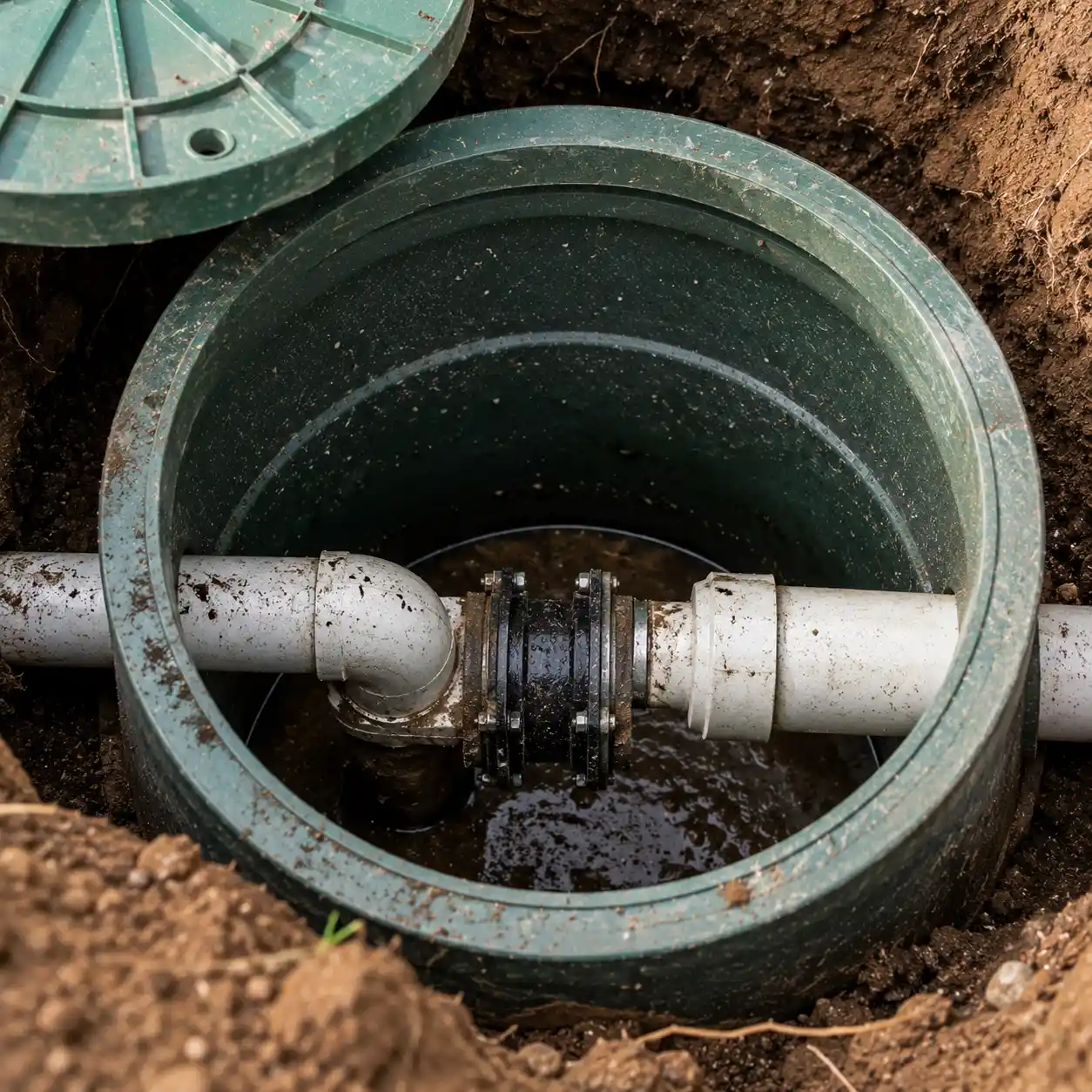
The Common Thread Behind Every Septic Emergency
Most people picture a septic emergency as something sudden — a backup, a bad smell that appears overnight, water pooling in the yard out of nowhere. In our experience, it’s rarely sudden. The system usually gave off smaller signals for weeks or months first, and those signals got attributed to something else: an old house settling, a slow drain that’s “just how it’s always been,” a wet patch blamed on a recent rain.
The seven signs below are the ones we hear about most often after the fact — the things a homeowner noticed, dismissed, and then mentioned again once the problem had already gotten worse. Catching any one of these early is almost always the difference between a routine service call and an expensive repair.
Warning Sign 1: Slow Drains Throughout the House
A single slow drain is usually a local clog — hair in the bathroom sink, grease in the kitchen line. A septic problem tends to show up differently: several drains around the house running slower than usual at roughly the same time, even fixtures that aren’t connected to the same branch of plumbing. That pattern points to something happening downstream, at the tank or beyond, rather than in any one pipe.
It’s easy to miss because it develops gradually. The shower that used to drain in ten seconds now takes fifteen, then twenty, over the course of a few weeks. By the time it’s obviously slow, the tank may already be close to full or the field may already be struggling to accept water at its normal rate.
Warning Sign 2: Gurgling Sounds in the Pipes
A gurgling sound after you flush a toilet or run a sink is air being forced back up through the plumbing because it can’t escape normally through the vent system or move freely downstream. In a septic system, that’s often a sign the tank is at or near capacity, or that something in the line between the house and the tank has partially blocked. It’s one of the more reliable early indicators precisely because it’s unusual enough that people tend to notice it, even if they don’t immediately connect it to the septic system.
Warning Sign 3: Sewage Odor Indoors or Outdoors
A properly functioning septic system shouldn’t produce a noticeable odor, indoors or out. A sulfur or sewage smell near a drain, in a basement or crawlspace, or out in the yard near where you know the tank or field sits is one of the more direct signals something’s off. Indoor odor often points to a dry P-trap or a venting issue rather than the tank itself, but it’s worth ruling out a septic cause rather than assuming it’s something else.
Outdoor odor near the drain field is more often a direct sign that effluent is surfacing or that the field isn’t absorbing water the way it should. That’s not something to wait out — it usually gets worse, not better, on its own.
Warning Sign 4: Standing Water or Soggy Ground Over the Drain Field
A little dampness after a heavy rain is normal almost anywhere. Standing water or consistently soggy, spongy ground over the drain field on days when the rest of the yard is dry is a different situation — it usually means the field is releasing more liquid than the soil can absorb, whether that’s because the field is failing, overloaded, or simply saturated from a tank that’s overdue for pumping.
This sign is easiest to catch if you already know roughly where your field is located. If you’re not sure, that’s actually a good reason on its own to schedule an inspection — knowing the layout of your own system makes every other sign on this list easier to interpret.
Warning Sign 5: Unusually Green or Lush Grass Over the Tank or Field
A strip of grass that’s noticeably greener and grows faster than the surrounding lawn, right along the path of your drain field, is a sign the ground underneath is getting extra moisture and nutrients — effectively free fertilizer from effluent that’s surfacing or sitting closer to the surface than it should. It’s subtle enough that a lot of homeowners notice it as a nice-looking lawn feature for months before connecting it to anything else on this list.
Warning Sign 6: Sewage Backup in the Lowest Drains
Basement floor drains, downstairs bathrooms, and laundry lines tend to back up first because they sit at the lowest point in the plumbing system. If you notice water or sewage coming up through one of these before it shows up anywhere else, that’s usually the system telling you it’s already at or past its limit, not an early warning — it’s a sign the problem has been building for a while.
Warning Sign 7: A Toilet That’s Slow to Refill or Gurgles After Flushing
This one gets attributed to an old toilet more often than any other sign on this list, and sometimes that’s exactly what it is. But a toilet that gurgles or takes noticeably longer than it used to before refilling, especially if it started around the same time as slower drains elsewhere in the house, points back to the same underlying issue: something downstream isn’t moving water through the system the way it should.
Noticing One or More of These?
An inspection now usually costs a lot less than waiting for a full backup.
Schedule an Inspection
Serving Columbia and all of the Midlands.
What’s Usually Behind These Signs
Most of the time, these signs trace back to one of three underlying causes. The first and most common is simply a tank that’s overdue for pumping — solids have built up to the point where the tank can’t hold and separate waste properly, so more of it moves downstream than should. The second is a drain field that’s struggling, whether from age, overload, or a biomat layer that’s clogged the soil’s ability to absorb water. The third, less common but worth mentioning, is a physical blockage or damaged pipe somewhere between the house and the tank, sometimes caused by tree roots working their way into a joint or a line that’s settled or shifted over time.
The reason we don’t guess over the phone is that these three causes need genuinely different fixes, and treating the wrong one wastes time and money without solving the actual problem. A tank that needs pumping doesn’t get fixed by drain field work, and a struggling field doesn’t get fixed by pumping alone if the underlying issue is a clogged biomat layer.
What to Do Next
If you’re seeing one sign on this list, it’s worth a call. If you’re seeing two or more at the same time, we’d treat that as a reasonably urgent situation rather than something to schedule around your convenience. In either case, the first move isn’t to try a store-bought additive or a DIY fix — those products rarely address the actual cause, and in some cases they can make a struggling field worse by disrupting the bacterial balance the system depends on.
An inspection tells you which of the underlying causes you’re actually dealing with, and gives you a real quote for the right fix rather than a guess. Most of the time, catching a problem at this stage means a straightforward pump-out or a targeted repair — not a full system replacement.
Get an Honest Read on What’s Actually Wrong
If something on this list sounds familiar, don’t wait for it to turn into a full backup. We’ll diagnose the actual cause and quote the right fix.
- Full system inspections with written findings
- Tank pumping when that’s the actual issue
- Drain field diagnostics and repair
- Blockage and line inspection
- Honest, no-pressure recommendations
- Serving all of the Midlands
Tell Us About Your Needs
We’ll reach out to confirm your appointment details.