Why Does Your Yard Smell Like Sewage — Even Though Nothing’s Backed Up?
A sewage smell outdoors with no backup inside the house is a confusing thing to deal with, since everything seems to be working fine. Here’s what’s actually behind that smell, from the small and easy fixes to the ones worth a professional look.
The Smell Doesn’t Always Mean What You Think
When homeowners smell sewage outside and nothing’s actually backed up in the house, the assumption is almost always the same: the septic tank must be failing. Sometimes that’s true. More often, it isn’t — a tank can be working exactly as designed while a completely separate, much smaller issue is letting odor escape somewhere it shouldn’t.
What the “it’s probably the tank” assumption leaves out is that septic systems have several points where sewer gas can escape if something’s slightly off — a dried-out trap, a loose lid, a blocked vent — none of which mean the system is failing. On the other end of the spectrum, an early-stage drain field problem really can cause an outdoor odor days or weeks before it ever shows up as a slow drain or backup inside. The smell alone doesn’t tell you which one you’re dealing with. What follows does.
One more thing worth knowing before you start troubleshooting: septic gas isn’t just unpleasant, it can be genuinely hazardous in enclosed or poorly ventilated spaces. Outdoor odors are almost always a nuisance-level issue rather than a safety one, but if you ever notice a strong sewer smell indoors combined with headache or dizziness, that’s worth treating as a ventilation emergency, not a septic curiosity — open windows, get fresh air circulating, and call a professional.
A Dry P-Trap Somewhere in the House
Every drain in your house — sinks, tubs, floor drains, even that laundry sink in the basement nobody uses — has a curved section of pipe underneath called a P-trap. It holds a small amount of standing water at all times, and that water is what physically blocks sewer gas from traveling back up through the drain and into your house. When a drain goes unused for weeks at a time, that water slowly evaporates, and once it’s gone, there’s nothing stopping gas from coming through.
This is one of the most common causes we run into, and one of the easiest to rule out. Guest bathrooms, unfinished basement drains, and outdoor hose bibs with a P-trap setup are the usual suspects. If you smell sewage but it seems to be coming from inside a specific room rather than the yard itself, check for a rarely used drain nearby before assuming it’s a septic problem at all. A quick fix here is simply running water down that drain for thirty seconds or so to refill the trap.
A Loose or Cracked Tank Lid
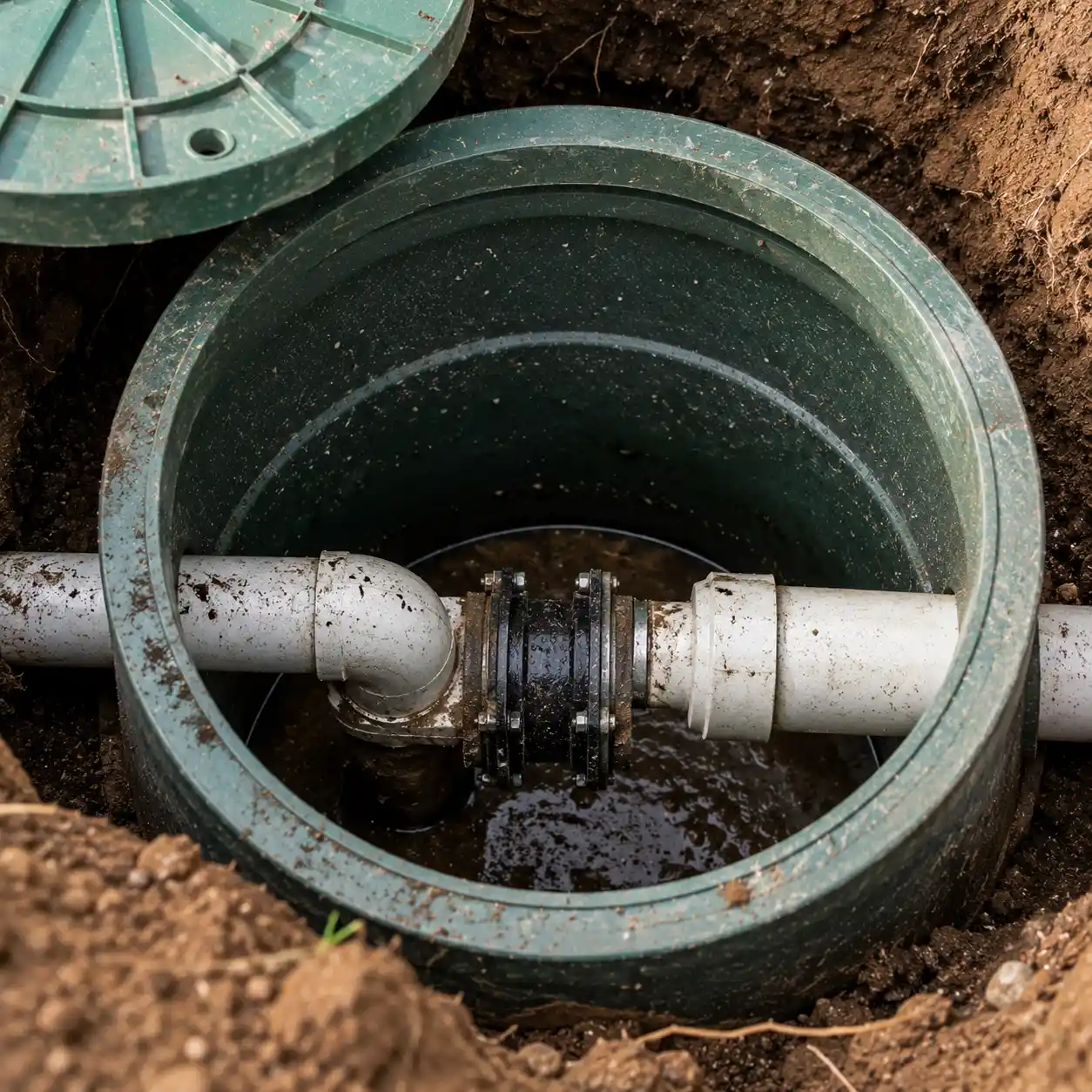
Tank lids take more abuse than people realize — freeze-thaw cycles, a mower running over them season after season, or just decades of settling can leave a lid slightly shifted or hairline cracked. When that happens, gas that would normally stay contained inside the tank finds its way out right at the surface, usually producing a smell that’s noticeably stronger in one specific spot of the yard than anywhere else.
This doesn’t mean the tank itself is malfunctioning — it’s purely a seal issue, and usually a simple fix once located. The tricky part is finding it, since a shifted lid buried under a few inches of soil and grass doesn’t always show an obvious visual clue.
A Blocked or Damaged Roof Vent Stack
Your plumbing system relies on a vent stack that runs up through the roof to release sewer gas safely above the house, while also letting air into the drain lines so water flows properly. Leaves, pine straw, or even a bird’s nest can block that vent, and once it’s blocked, the gas has to find somewhere else to go — sometimes venting out at grade near a cleanout instead of the roofline, which can smell a lot like a tank problem from ground level.
A blocked vent can also cause gurgling drains alongside the odor, since the air-pressure balance the vent is supposed to maintain gets disrupted. If you’re noticing both, this is worth checking before assuming the worst about the tank.
Early Drain Field Saturation
This is the one worth taking seriously. A drain field that’s starting to struggle — whether from age, overload, or a run of heavy Midlands summer rain — can produce a sulfur-like odor over the field well before any drains inside the house are actually affected. The field is partially saturated at this stage, not fully failed, which is exactly why catching it now instead of waiting matters: a partially saturated field usually has real repair options, while a fully failed one often doesn’t.
Pay attention to whether the smell is concentrated over the area where your drain field actually sits (grass over the field is often a shade greener than the rest of the yard, which helps locate it) and whether it gets noticeably worse after rain. That pattern points toward the field rather than the tank lid or a house-side issue.
Effluent Filter or Baffle Trouble
Some tanks have an effluent filter installed at the outlet baffle, designed to catch solids before they reach the drain field. When that filter starts clogging, it doesn’t necessarily cause a backup right away — tanks are built with some buffer — but it can cause noticeably stronger gas venting near the tank as pressure builds behind the clog. Not every system has one of these filters, so this cause is more specific than the others, but it’s worth mentioning to whoever comes out to look, since it’s a quick check once the tank’s open.
Not Sure What’s Causing the Smell?
We’ll track it down before it turns into a bigger problem.
Schedule a Diagnostic Visit
Serving Columbia and all of the Midlands.
How We Actually Track Down the Source
Diagnosing an outdoor sewage smell starts with ruling things out in order of likelihood and ease. We walk the property to note exactly where the odor is strongest, check tank lids and access points for cracks or shifting, and inspect the vent stack if we suspect it’s involved. If those all check out, we open the tank to look at baffle and filter condition, and run a dye test if there’s any reason to suspect the drain field is where the real problem is.
This methodical approach matters because the fix for a dry P-trap and the fix for early drain field saturation are about as different as it gets — one is a five-minute check, the other could mean scheduling a repair before things progress. Guessing wrong wastes time on a problem that isn’t actually there while the real one keeps developing.
What to Do While You Wait for Service
Run water down any drains in the house you don’t use regularly — this rules out the simplest cause and costs you nothing. If you suspect the smell is coming from over the drain field, especially after rain, it’s worth easing up on laundry and other high-water tasks for a day or two so you’re not adding more volume to a system that might already be struggling to keep up.
What we wouldn’t recommend is ignoring it and hoping it clears up on its own. An odor with no obvious cause is one of the few septic symptoms that’s genuinely worth a call even before anything backs up, simply because the range of possible causes is wide enough that guessing isn’t a great strategy — and if it does turn out to be early field trouble, the earlier it’s caught, the more options you have.
One last thing worth remembering: the smell itself doesn’t tell you how urgent the situation is. A dry P-trap producing a strong odor can feel alarming but costs nothing to fix. A faint, easy-to-dismiss smell over the drain field after a heavy rain can be the first sign of something that genuinely needs attention. Don’t let the intensity of the odor be your only guide to how seriously to take it — the location and pattern matter more than how strong it smells on any given day. When in doubt, a quick professional look is a lot cheaper than waiting to find out the hard way.
Get the Smell Diagnosed and Fixed
Describe what you’re noticing and where, and we’ll bring the right equipment to find the actual cause.
- Full property odor diagnosis
- Tank lid & access point inspection
- Vent stack check
- Baffle & effluent filter inspection
- Drain field dye testing if warranted
- Serving all of the Midlands
Tell Us About Your Needs
We’ll reach out to confirm your appointment details.